01
Black-box output
A probability without reasoning gives reviewers little context for understanding what pushed an application toward risk.


An explainable credit-risk platform that turns machine-learning predictions into decisions people can inspect.
(Overview)
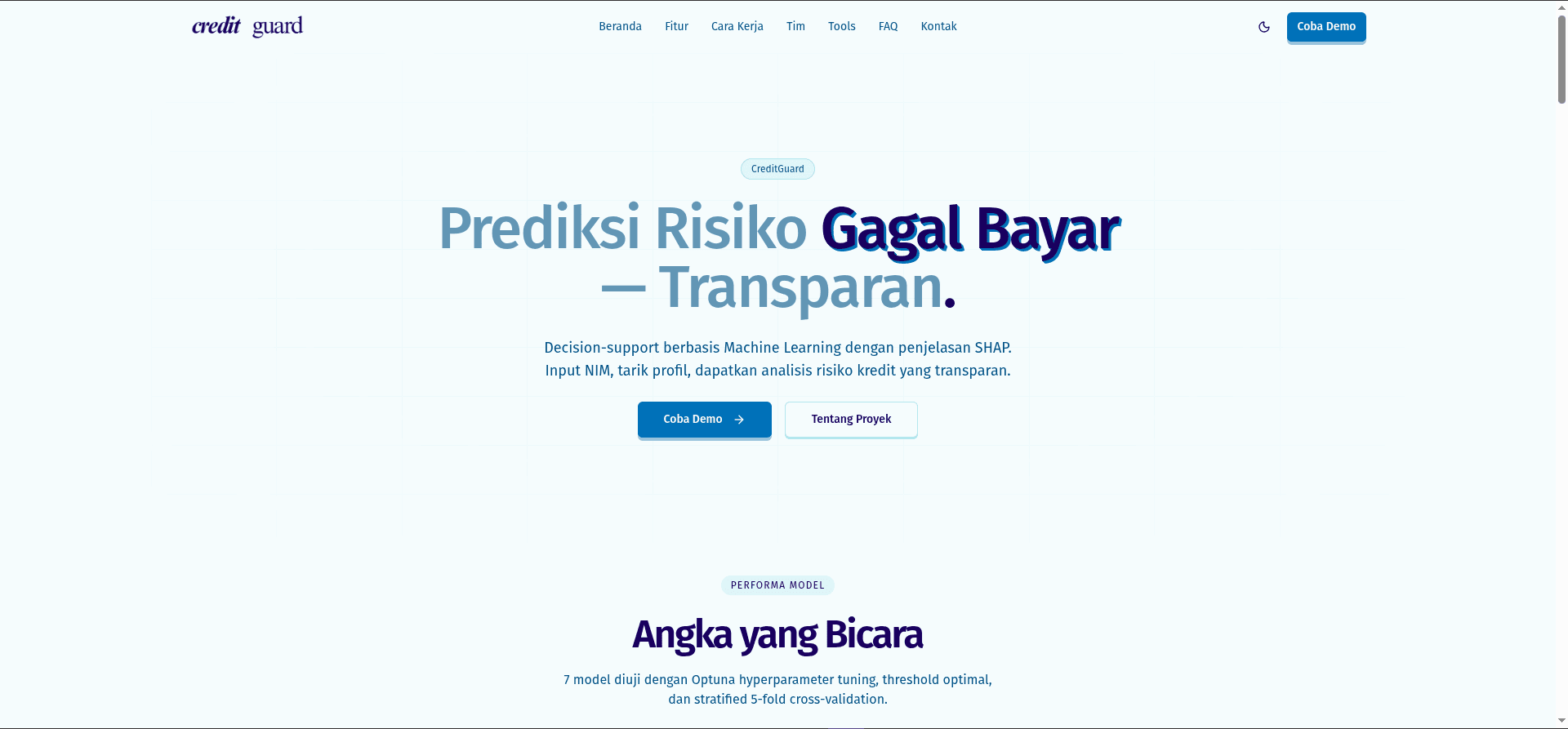
Credit Guard combines credit-risk modeling with a clear web experience. Instead of presenting a prediction as a black box, it exposes the contributing signals so the result can support a more informed review.
Type
Decision-support platform
Role
Full-stack & machine learning
Focus
Credit risk · explainability · UX
Status
Live product
(Introduction)
Credit Guard translates model output into a transparent decision-support experience built for inspection, not blind acceptance.
(Problem)
Financial models can produce confident outputs while remaining difficult to interpret. That creates friction for anyone who needs to review, explain, or challenge the result.
01
A probability without reasoning gives reviewers little context for understanding what pushed an application toward risk.
02
Multiple candidate models, thresholds, and validation strategies had to be compared without optimizing for one misleading metric.
03
Feature importance and model confidence needed to become approachable information instead of remaining machine-learning terminology.
(Approach)
The work connected model evaluation, threshold selection, SHAP explanations, and interface hierarchy into one flow. Every technical output had to answer a practical user question.
(Solution)
Users can provide an applicant profile, receive a risk analysis, and inspect which factors contributed to the result. The interface keeps the model visible without overwhelming the decision-maker.
01
A focused input flow produces a structured probability of payment default.
02
Contributing features are surfaced so the reasoning behind a result can be examined.
03
Candidate models are evaluated through a repeatable validation and tuning process.
04
Technical signals are translated into a hierarchy that supports faster review.
05
The experience distinguishes prediction from certainty and avoids presenting the model as a final authority.
06
Model behavior, API integration, and the frontend were shaped as one product system.
(Outcome)
Credit Guard demonstrates how model evaluation and product design can reinforce each other. Accuracy matters, but the ability to inspect the result is part of the system's usefulness.
The final platform turns a technical prediction pipeline into a clearer conversation about risk, evidence, and human judgment.